Practise interviewing a child. Without a child.
METKA is a training platform for forensic interviews with children. An instructor drives a realistic child avatar in real time and a trainee interviews it — and every session is recorded, annotated and turned into teaching material.
Runs in the browser. No sign-up needed to practise — just a session password.
Why METKA
The one interview you cannot rehearse in real life
An interview with a child happens once. It cannot be repeated, and a mistake in it can be impossible to undo. METKA gives that interview somewhere safe to go wrong.
No child is put through it
The person on the other side is an avatar driven by an instructor. Repeat the exercise as often as you like — mistakes cost a real child nothing.
The instructor steers it live
Choose the child's age and sex, their mood, their actions and the room — and turn the scenario up or down mid-session.
Every session stays useful
Recordings do not go in a drawer. Mark the good examples and the common mistakes, then build lessons out of them for the next intake.
How it works
From exercise to teaching material in four steps
The instructor takes the avatar
Their voice is converted to a child's in real time, and their facial expressions can be driven from an iPhone.
The trainee interviews it
In the browser, nothing to install. The avatar looks, reacts and answers live.
The session is recorded
Avatar and trainee are captured side by side. Afterwards you download the file and upload it to the platform.
The recording becomes a lesson
Mark passages as good practice or a common mistake, then drop them straight into a lesson.
The two sites
One address to practise, another to keep the work
The live exercise happens on one host; the library of recordings and lessons lives on the other.
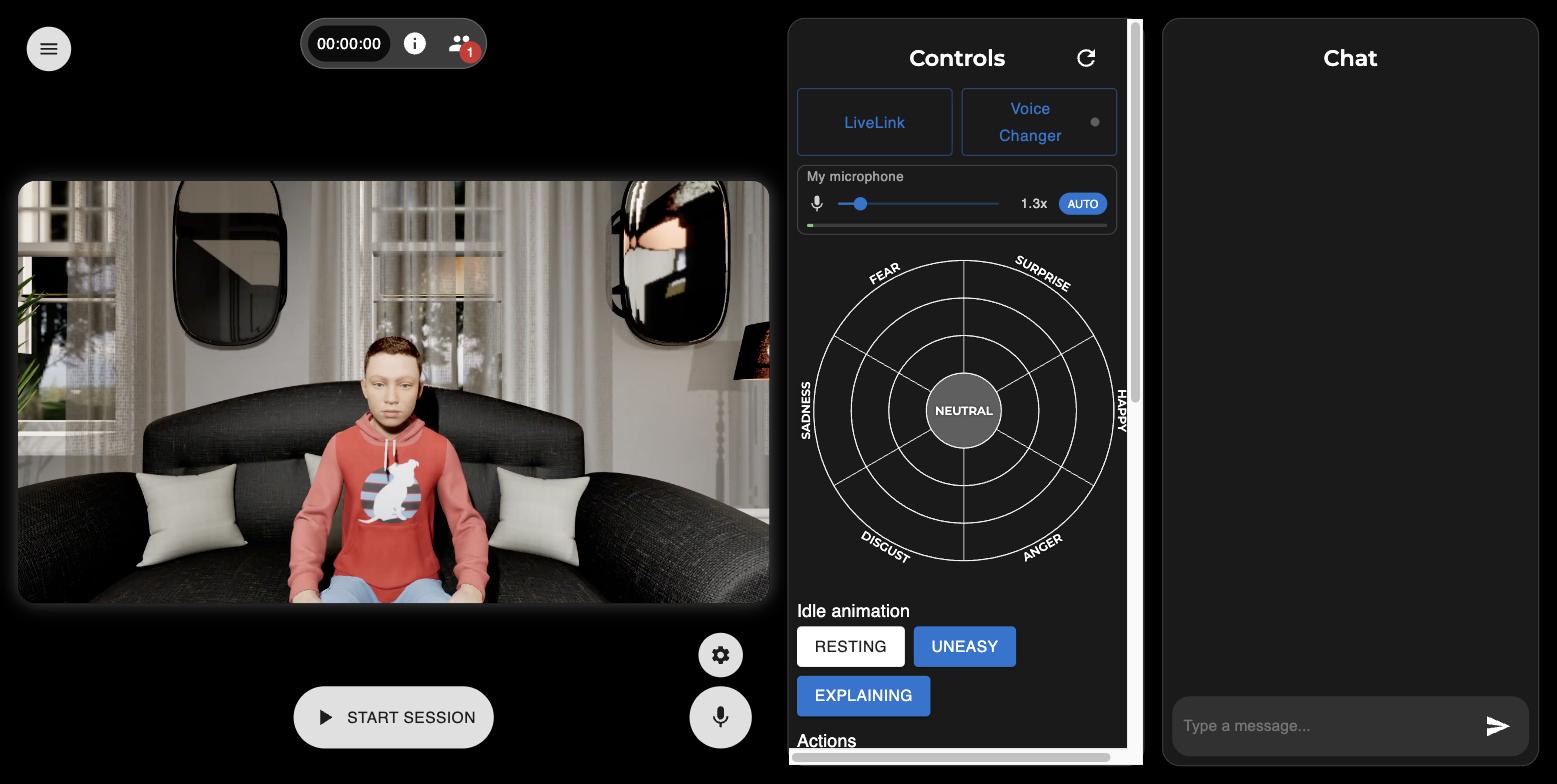
app.metka.ai
The live session
Where the interview with the avatar happens and the recording is produced. No login — everyone enters the same session password.
platform.metka.ai
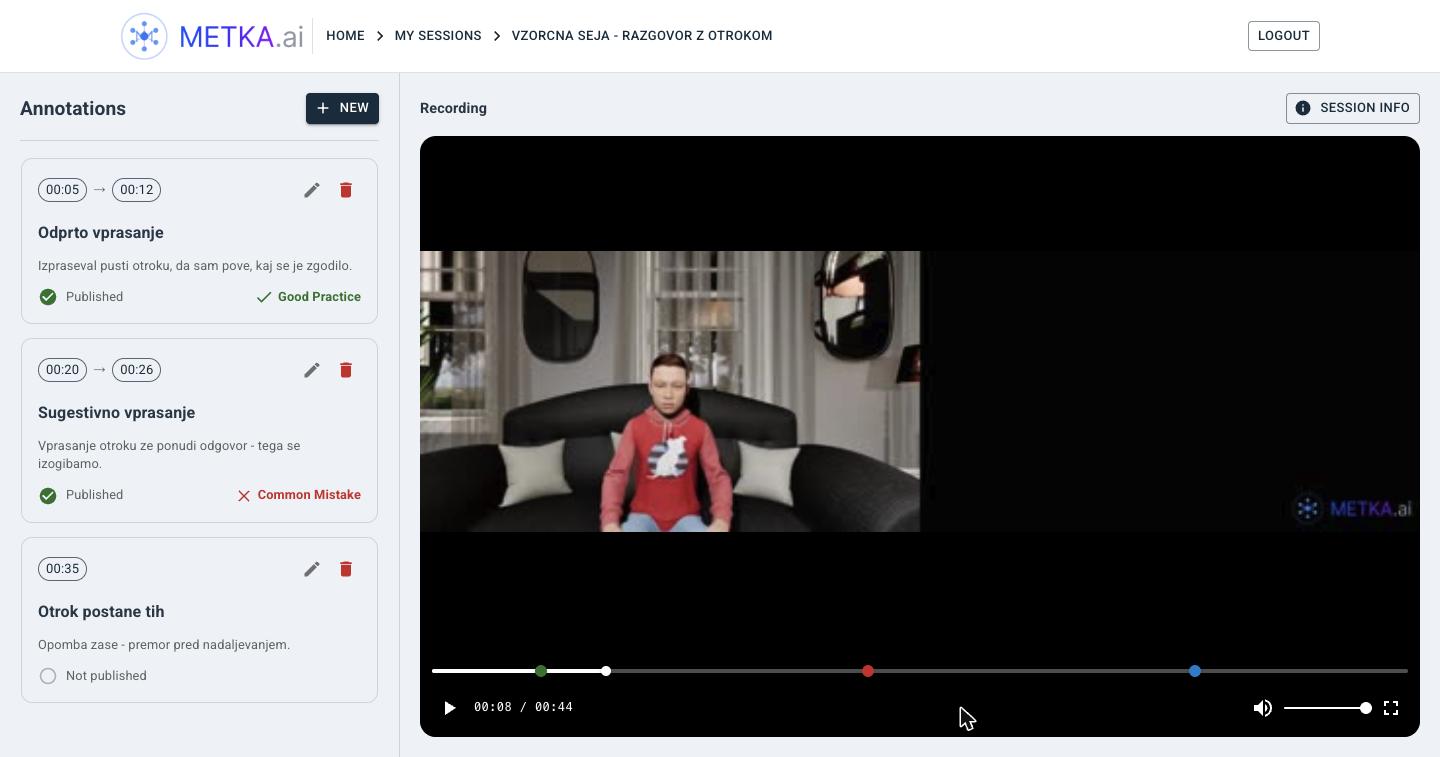
Recordings, annotations and lessons
Your organization's library. Upload a recording, mark the moments that matter and build lessons from them. An account is required.
app.metka.ai/manual
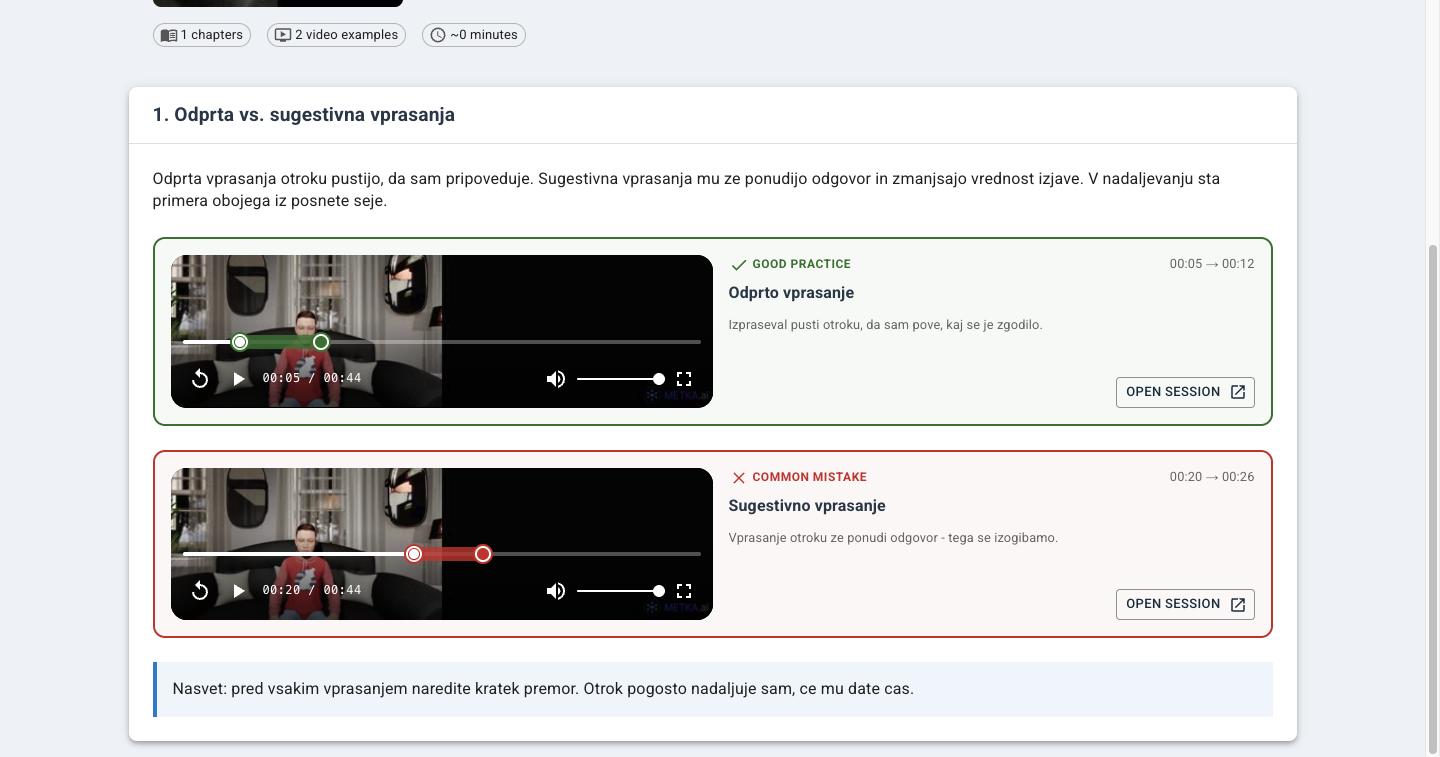
User manual
Step-by-step instructions with screenshots, from a first session to a finished lesson. Available in Slovenian and English.
Want to use METKA in your training?
Get in touch for a platform account, a walkthrough of the system, or to talk about working together.
About the project
Research that runs in production
METKA is built at the Faculty of Computer and Information Science, University of Ljubljana. It is aimed at professionals whose work involves interviewing children, and at the institutions that train them.
At its centre is a child avatar running in a game engine and streamed to the browser with a delay small enough to hold a conversation. The instructor lends it their performance — speech, expression, emotion and action — so the trainee spends the whole session talking to a child, not to a program.
The second half matters just as much: without a recording and a review, an exercise stays an anecdote. So every session is a recording, and every recording is a source of marked examples that lessons are built from.
The system is in pilot use and under active development.
Technology
- AvatarUnreal Engine 5, MetaHuman
- StreamingWebRTC Pixel Streaming
- FaceiPhone ARKit, Live Link Face
- Voicereal-time conversion to a child voice
- Audiomediasoup SFU
- PlatformDjango and React
FAQ
Before you start
Do I need to install anything?
No. Both the session and the platform run in the Chrome browser. If the instructor also wants to drive the avatar's facial expressions, they need an iPhone with the free Live Link Face app — step-by-step instructions are shown inside the app.
Do I need an account?
Not for a session on app.metka.ai. A session password you make up yourself is enough; everyone who enters the same password lands in the same session. The platform with recordings and lessons does need an account — write to vid.klopcic@fri.uni-lj.si.
Who can see my recordings?
A recording you upload to the platform is visible to everyone in your organization, and so are all the annotations on it. There are no private sessions — if you do not want to share a recording, do not upload it.
How many people can join a session?
An instructor runs the session, a trainee interviews the avatar, and observers can join as supervisor to watch without taking part.
What languages is METKA available in?
The user manual is available in Slovenian and English. The application interface itself is in English.
Try it in a few minutes
Open a session, pick a role and type any session password. That is all you need for a first run.